
This post contains affiliate links. If you book something through these links I get a small commission at no extra cost to you. You can read more about my disclosure and affiliate policy here.
…
Kyoto used to be Japan’s capital for over 1000 years and has always charmed. In fact, so much so that it was taken off the list as a potential target of the atomic bomb in favor of Hiroshima (remember Oppenheimer?!). A stroke of luck for Kyoto as it has retained much of its traditional charm and historic buildings until today.
In addition, the city is small at least by Japanese standards, and pretty walkable for the most part. Add to this countless temples and shrines, a lively food scene, proximity to the best matcha in the world, and so much more – it doesn’t surprise that many consider Kyoto a stunner. You can stay a day, a week, or a month, chances are you won’t get bored – Kyoto makes it easy to feel right at home.
Admittedly most visitors won’t stay that long but you should at least plan a 2-day itinerary for Kyoto. Here are some tips for your trip and what to see and do during your stay.
My personal 2-day itinerary in Kyoto

Table of Contents:
What to see in Kyoto

Gion
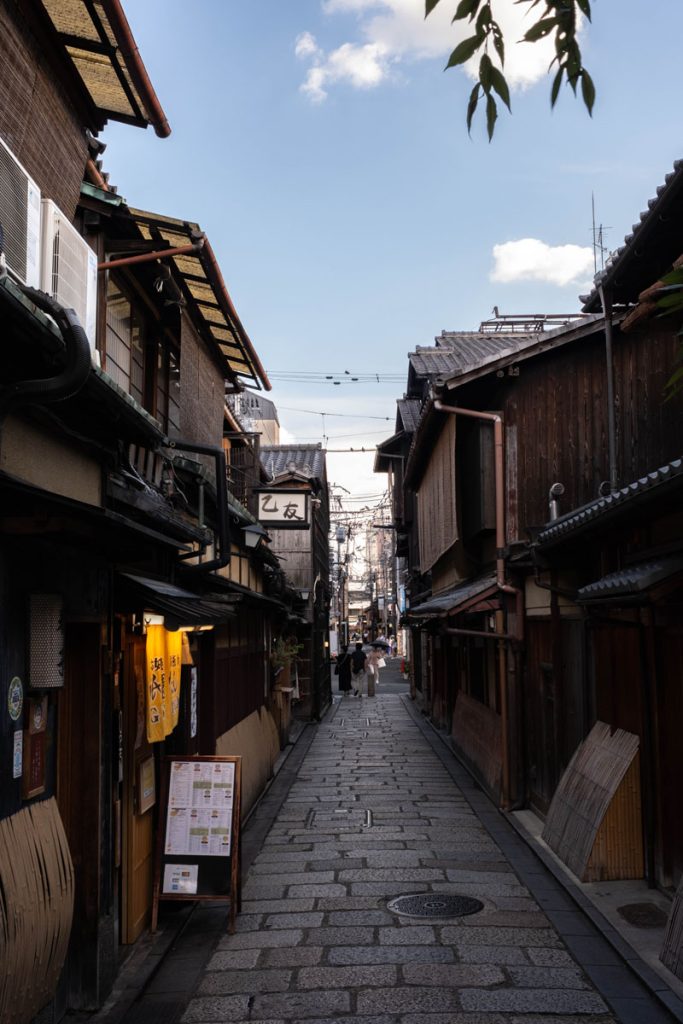
Gion is one of the old parts of town and is famouly known as Kyoto’s geisha district. Traditional wooden houses, teahouses, and restaurants mark the area. Gion’s most famous street is Hanami-koji where Gion Corner, a theatre, is located where even tourists can learn more about geishas and their art.

Only recently has the government cracked down on Gion or rather misbehaving tourists as geishas and maikos (apprentice geishas) were being harassed. It should go without saying, but if you see one do not chase, touch or take unsolicited pictures.
Instead – enjoy the unique atmosphere and go for a stroll!
My favorite was Shirakawa Lane, a beautiful alley by a little stream. There are some lovely and very expensive restaurants and ryokans (traditional Japanese inns) on the other side. It is as picturesque as it gets. Take your time for a picture on Tatsumi Bridge and make an offering at the little Tatsumi-jinja Shrine.


And if you love cats, go to Black Cat Coffee. It was here that I learned, to my utter delight, that black cats are considered good luck in Japan.


I recommend booking a walking tour to learn more about the geishas, the local traditions, and the history of the area.
Higashiyama District

The Higashiyama District is part of Gion and is known for traditional shops and cute, well-preserved streets. Probably one of the most iconic alleys in Kyoto is the Sannen-Zaka Path offering a perfect view over the Yasaka Pagoda. That is if your view isn’t obstructed by countless other tourists. Honestly, once the sun is up this little picturesque road is not so picturesque anymore. I still recommend you go see it because it is that popular for a reason.


If you only have time for a 1-day Kyoto itinerary book a Gion night walk. You will definitely walk through and maybe even get the chance for a somewhat unobstructed picture.
Alternatively, get up very early. And by very early I mean before sunrise. I arrived just in time for sunrise and I was not the only one. That said, when coming up from the Ninen Zaka Path with the beautiful Starbucks (unfortunately still closed for a few hours) turn left not right. Just walk a few meters up the road and your chances have increased by a lot to take a nice shot albeit not perfect.


After, walk down the road to get closer to the actual pagoda and take some more pictures. With spots like these, I like to be really courteous with other photographers. I always hope people or karma will return the favor.


Note that while taking pictures of the pagoda is definitely okay, there are many signs throughout that photography is not permitted. Admittedly even I discovered some signs too late. Make sure you are not doing anything illegal and remain respectful especially when people’s private properties and businesses are concerned.
Temples and shrines

If you enjoy visiting temples and shrines there are 1600 temples and 400 shrines in town – enough to fill a 5-day Kyoto itinerary. There is Kiyomizudera, one of the most beloved Buddhist temples in the country, and the Jishu Shrine. One of the most prominent is the Yasaka Shrine and the beautiful Maruyama Park behind as well as the Kodaiji Temple close by. I also liked the Yasui Kompiragū Shrine which you can climb through to make a wish and for good luck.


If you are interested in history and/or religion I recommend getting a very good guidebook or booking a walking tour as I did. This way you will see a few great temples, and viewpoints, and learn more about Kyoto and its history.
Fushimi Inari Shrine

One of the most famous or at least most photographed shrines is the Fushimi Inari Shrine with its countless red torii gates. There are apparently thousands of them. Inari is the Shinto god of rice often represented by foxes that are considered his messenger. With that, it doesn’t surprise that you will see plenty of fox statues around. As usual, I was more excited to run into a very real black cat.
The torii gates are built over various trails that lead through the woods of Mount Inari. They were built from donations either from individuals or companies and each gate shows their name. A cynic may call it advertising.


If you want to hike all the way up the mountain it will take about 2-3 hours though most visitors seem to come just for an Instagram picture or two. I will admit that I was one of them. Still, you are well advised to come very early in the morning and to walk a bit further than the average visitor. The further you go the better your chances for a decent picture. I realized I wasn’t going to set up my tripod and eventually just handed my phone to an eager Chinese guy who seemed to be taking nice enough pictures of his mother.


From Kyoto, there are various buses and trains to Inari. The easiest is to take the Nara JR line to Inari Station and you will arrive right by the shrine. The shrine is free to visit.
Nikishi market

Nikishi market is known as the Kitchen of Kyoto. Since it is a) centrally located and b) covered, you will probably come across it at one point or another. The atmosphere is unlike that at Tsukiji Outer Market in Tokyo though what is on offer is similar. That said, it has a 400-year-old history.


I ended up walking through a few times but it usually was too busy for my liking. At one stand I bought a Taiyaki with sakura (a sweet fish-shaped pastry with cherry blossom filling). In addition, I splurged on a small punnet of white strawberries which were absolutely delicious. But you can get seafood, wagyu, wagyu with seafood on top, and anything in between. There are also some nice stories to browse delicacies to take home. I liked the dog cookies from a cute vending machine that I bought as a souvenir.
Day trips from Kyoto

Have a little bit of extra time? Check out these day trips from Kyoto if you want to escape the city.
Uji Matcha Tour

Last time I was in Japan, I didn’t like matcha. Then I arrived back home and ate the matcha macadamia chocolates I got during my food tour in Hiroshima and immediately regretted not getting more. This is how my love for matcha started.
Now I love it in almost all varieties except strawberry matcha shenanigans.


With my return to Kyoto, it was high time to visit its birthplace (so to speak) and take a trip to Uji, home of some of the best matcha in the world. With that, I booked a Matcha Kyoto Green Tea Tour with Arigato Travel. This tour is so much more than just a tea ceremony, which you can book pretty much anywhere.


I met my tour guide Ako at the Uji station (already a highlight for its cool architecture) before we set off to explore the town. The tour is perfect if you want to learn more about matcha, try it in various states, and explore some of the sights in town, namely the famous Byōdō-in Temple and the Ujigami Jinja Shrine. The itinerary is the perfect mix between sightseeing, culture, and all things matcha. During the tour, you will learn the differences between matcha, sencha, and hojicha, how it is grown, and how the different varieties are prepared.


After some sightseeing, we started with a delicious tea-themed lunch – and yes, there was matcha in those noodles! From there, we took a stroll by the river and went to one of the oldest matcha producers in town. They have a small gallery telling the story of matcha and the house’s history. Once the history lesson is over, you will learn how to grind matcha yourself. And of course, how to prepare it properly. No strawberry shenanigans in sight…


Finally, it was time for some matcha shopping – could there be a better place than Uji? – and sweets. Since I chose a scorcher of a day, that meant matcha soft serve and shaved ice. And I finally got my own matcha whisk to put my newly learned skills to the test at home.
Book the Matcha Kyoto Green Tea Tour
Nara


If you have at least time for a 3-day Kyoto itinerary you should consider a day trip to Nara. This little place south of Kyoto and east of Osaka is known for its local, free-roaming deer population. Obviously, there are shrines as well but to be honest, most people seem to come for the deer. Or maybe the Motchisuki, the pounding of mochi dough at Nakatanidou, one of the most famous mochi bakeries in Japan.
Definitely take your time to walk around, play with the deer, take pictures, and eat mochi. Nara is a beautiful destination for a day trip from Kyoto.
Read more:
Meet Japan’s bowing deer – A day trip to Nara
The best hotels in Kyoto

RC Hotel
The RC Hotel is my new favorite hotel in Kyoto. First of all, it is such a vibe – a boutique hotel with a bit of concrete, some vintage furniture, and the nicest staff. The rooms are pretty big, especially for Japanese standards, and so comfortable. I especially loved the cool bathrooms.

However, the absolute best part about the RC Hotel is its location. It is literally right next to the Yasaka Pagoda. From some rooms, you can even see it from your bed – this is basically the equivalent of an Eiffel Tower view!
While there are plenty of tourists around during the day, you can sneak out of bed very early or stay up late to snap some shots uninterrupted – perfect for photographers. And while the hotel seems to be located on one of the busiest roads in Kyoto, you can get there by taxi. Alternatively, the bus station is just at the bottom of the road.


Last but not least: the price is right. The RC Hotel is very affordable, especially considering the room size and its A+ location.
Check prices on Booking / Agoda
node, a Member of Design Hotels
I also stayed at node, a Member of Design Hotels and easiest one of the coolest hotels in Kyoto. I opted for a slightly larger double room that was still affordable. It was the perfect size for a single traveler with a very large suitcase. They also have a nice bar/restaurant downstairs though I only used it for my welcome wine.


While I liked node overall, the location wasn’t ideal. When I go back I would choose a Gion Kyoto hotel or at least something closer to the Kamo River and the city center. The next subway station was less than a 10-minute walk from node. But since there are so few lines, I ended up walking A LOT and taking more taxis than usual.
Check prices on Booking / Agoda
Eating in Kyoto

Eating in Kyoto became a bit of a mission much like anywhere else in Japan. I didn’t want to spend a fortune or deal with the crazy Japanese booking systems nor did I want to queue for hours. With that, I often found myself googling “Kyoto restaurant near me” and I have to say the system served me well. In addition, I stuck to my early bird dining times to avoid queues. While this usually meant lunch at 11 am and dinner at 5 pm it worked well to avoid waiting times.
An exception was Hikiniku to Come, an Insta-famous restaurant in Kyoto that serves nothing but burger patties with rice. Yes, you read correctly. That said, they are truly the perfect patty and are served with a variety of yummy condiments and seasonings.


Another favorite was Handmade Udon & Soba Shōraku not far from node. Both my udon and the tempura were absolutely delicious and it was inexpensive. I also felt so welcome despite being the only foreigner. In fact, the waitress seemed genuinely excited that I had somehow managed to find their little restaurant.


A similar lucky find was Coppie, a modern Japanese restaurant with a reasonably priced omakase menu and natural wines. I arrived for a very early dinner and got seated at the kitchen counter. The menu is only in Japanese so I used the Naver Papago app for a bit of “help”. I quickly decided to not order a la carte and went for the set menu minus the whale, one of the words my app detected correctly. It was delicious and both the staff as well as the other patrons were so welcoming and kind. Honestly, I have rarely felt that welcome when eating alone.


I also went to the main branch of Honke Owariya, allegedly the oldest soba noodle restaurant in Japan. The setting in an old wooden house was beautiful and eating soba noodles the traditional way was an interesting and very delicious experience.

Back to the future was my meal at Kaiten Sushi Ginza Onodera, a conveyor-belt sushi restaurant. It was inexpensive and honestly, I felt like a kid in a candy store. You order via tablet, and whoosh – your sushi arrives on the belt in front of you in what feels like lightspeed.


The one Kyoto foodie guide recommendation I did follow was to have matcha tiramisu at MACCHA House. While I didn’t love the setting and was not able to appreciate pure matcha tea yet, the tiramisu was lovely and probably helped on my way to becoming a matcha lover.
Experiences & food tours in Kyoto

Casual Pontocho Evening Tour
Pontocho is such a fun area in Kyoto, but I will admit that wandering the streets alone can be a bit, well, lonely. With that, I booked the “Kyoto Casual Pontocho Evening Tour” from Arigato Travel to have some company and find some great food options. Pontocho is one of those areas where you should know where you are going; otherwise, unassuming entrance doors or long lines can be intimidating.

We started our evening with some local snacks and sweets that we got to take home as well – one of my favorite features when doing Arigato tours. Afterward, we visited a few different, very local places for dinner.
It started with sake and chicken yakitori – the perfect opportunity to try a variety of chicken cuts. My favorite was the chicken with leek, though even the chicken tails and hearts were good and not something I would have probably tried on my own.


From there, we wandered through the streets, learning more about the history of the area and Kyoto overall. At the next restaurant, I got one of my favorites: plum wine on the rocks. In terms of food, the options were endless, and we tried the fluffiest omelette, potato salad (interesting one for a German), sushi, chicken karage, and the best agadashi tofu I ever had. While I don’t mind sharing during these food tours, I was sad having to share that one…


Our final stop was a local ramen restaurant. As I am not the biggest ramen fan, I was happy to learn that their other specialty was gyoza, which we all ended up choosing.

With full bellies, it was time for a final stroll before we got a big bag with snacks for takeaway and a beautiful final shot of the Kamo River in the evening light.
Book the Kyoto Casual Pontocho Evening Tour
The Essence of Tempura and Dashi

Want to have a truly unique experience in Kyoto? How about exploring the essence of tempura and dashi? I chose this Wabunka experience because I love dashi and katsuobushi, but I am not the biggest fan of tempura. Most tempura I have had was too oily and/or thick for my liking. With that, I was curious if I could be swayed by a proper tempura master.
The experience is set in a very special restaurant in the Higashiyama area, where head chef Masaru Oba will share his magic. As with most Wabunka tours, a personal translator will join you for the workshop part of the tour, and all the notes are also in English.


First up: dashi making and dashi tasting. What can easily be described as the heart and soul of Japanese cooking – dashi – is a true art, and you learn how it is almost blended like wine here. Needless to say, I had to show off my katsuobushi shaving skills to the chef after having just practiced in Okinawa.
After our tasting, it was time for the meal: a multi-course tempura dinner. The meal is served both by Chef Oba and his apprentice, and each course is accompanied by an English notecard telling you what you are about to eat and how to eat it. The dishes are accompanied by various salts, and the notes recommend which one to use.


Ingredients are always seasonal, but my favorite was the white corn tempura and the basil sorbet & tomato dessert. While you eat, you can watch the team behind a glass window preparing your tempura. And you can marvel at the fact that each piece is put on a little piece of paper in front of it – without leaving any trace of oil. With that, I am now a newly converted tempura fan – as Masaru Oba’s tempura is a masterpiece just how it should be.
Book the Essence of Tempura and Dashi
How to get to Kyoto & how to get around?

Kyoto doesn’t have its own airport so you either have to fly to Osaka or Tokyo. If you are coming from overseas you would arrive either at Tokyo Haneda or Narita or at Osaka Kansai. For a domestic flight, you can also transfer via Osaka Itami which is now considered the domestic airport.
If you are heading to Osaka Kansai you can simply take the JR Haruka train from Kyoto Station. It is fast and goes directly, and if you are lucky you will even get a Hello Kitty train.
Trains to Kyoto
From both cities, it is very easy to take the Shinkansen to Kyoto though. Heading from Tokyo to Kyoto, you can use the Tokaido Shinkansen which will take about 2 hours. If you are coming from Osaka to Kyoto it is less than 30 minutes with the Tokaido-Sanyo Line. The Hankyu-Kyoto Line takes a little longer but might be a good option if you don’t have a Japan Rail Pass as it is a private railway company.


For a very scenic ride, you can also use the Aoniyoshi train from Osaka-Namba to Kyoto. It only costs a little more and is a truly wonderful experience. I took it on my day trip to Nara as it is considered a tourist train though nobody will mind if you simply use it as a mode of transport.
Getting around Kyoto
Getting around Kyoto is unfortunately not the easiest as the public transport options are somewhat limited compared to other Japanese cities. There are 2 subway lines and a few local railway lines as well as buses. However, I quickly realized that didn’t help me, staying at node which was a few blocks west of the Karasuma Line.


While the main shopping area of Kyoto is not huge it can feel quite far if you are walking. Also, connections to Gion and the Higashiyama District are limited so I found myself taking a lot of taxis and Uber in Kyoto. Luckily Kyoto taxi prices were reasonable but of course more than public transport.


A good alternative would be a bicycle rental when the weather is nice. You can even rent e-bikes and there are many designated bike lanes as well as parking in Kyoto.

