
This post contains affiliate links. If you book something through these links I get a small commission at no extra cost to you. You can read more about my disclosure and affiliate policy here.
…
I had two must-dos when I put together my Japan itinerary: see snow monkeys and the bowing deer in Nara. With that in mind, I organized a trip to Shibu Onsen and my stay in Kyoto for a day trip to Nara. The little city is located less than an hour by train from Kyoto. Its wild deer population is the main draw for tourists, but there are a few other things to do and see as well.
In this article, I will share my tips on how to plan your day trip to Nara and meet the cute deers.
How to plan a day trip to Nara

Table of contents:
The bowing deer in Nara
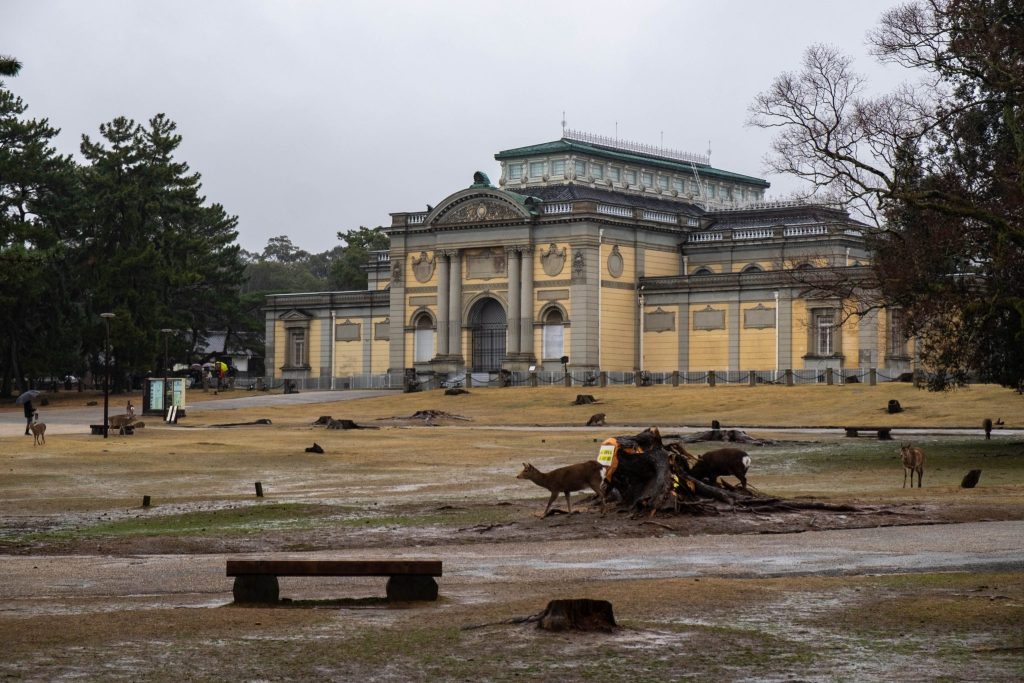
The bowing deer in Nara are pretty much world-famous. They are considered messengers of the gods and have been declared a national treasure of Japan. The Nara (Deer) Park is quite big and home to approximately 1,400 wild sika deer. There are no fences, no nothing around the park – they are free to roam. This often includes the surrounding streets and you can be sure that the deer will stop traffic. Nobody wants to run over a messenger of the gods!


I arrived on a pretty miserable rainy day for my Kyoto Nara day trip. Unfortunately, didn’t have a chance to move things around so I just had to go withit. Luckily it is only a short walk from the station to the deer park and I had gotten a typical Japanese 7-Eleven umbrella. The whole park is about 502 hectares and as I mentioned the deer are not contained to the park. I was scared they would all be hiding from the rain but I realized deer are pretty robust. While I felt sorry for the cute deer getting drenched, they didn’t seem to mind all that much.

At the inofficial entrance to the park, there are a few spots where you can buy deer cookies to feed them. It is not recommended to feed them with other things. Obviously, there was quite a crowd around those “feeding stations” but to be honest, I didn’t like it. The deer seemed quite a bit cheekier, some even aggressive to get the treats (unlike the ones on Miyajima Island which you cannot feed). I saw a few people get nibbled on and I am sure purses have been lost to curious dees. There are also warning signs that deer may headbutt you.


I walked away from those crowds and the deer cookies. The park is huge and most people don’t walk very far. However, I went into the park for a few hundred meters – it is actually beautiful and there are deer all over. The further you walk, the better the chances you will get a few deer all to yourself. I recommend you do the same, rain or shine.


While I was there in mid-March the park is open all year long and there will be deer. Obviously, Nara is very popular during cherry blossom season and fall foliage. I saw a few blooming trees and can only imagine how magical it would have looked a couple of weeks later on a sunny day. Cinderella would have had a field day.


As it was, I was pretty happy with my new deer friends – and yes, if you say “ohayou gozaimasu” and bow, the deer will bow back at you. They are not called the bowing deer of Nara for no reason.
How to take pictures at Nara Park


Yes, I was the girl with the tripod. I am not even ashamed to admit it – I wanted cute deer selfies. I travel with this tripod which I connect via remote control to my iPhone. If you want more professional pictures you can book a session with a photographer in Nara.
Private Photoshoot Experience in Nara
Other things to do & see in Nara
Most visitors come for the deer, however there are a few other things to see and do in Nara.
See the Nara temples

Considering that Nara was Japan’s first permanent capital it is also home to many important Buddhist temples. This includes the Todaiji Temple and the Horyuji Temple.
The Todaiji’s Temple also known as the Great Eastern Temple is one of the most important Buddhist temples in Japan and is home to a 15 m tall bronze Buddha. The hall where the Buddha sits was once the world’s largest wooden building – it was only surpassed quite recently by buildings like the Odate Jukai Dome, a wooden baseball stadium.
The temple is located in the northern part of the deer park so chances are you can combine both during a visit. Entrance fee is ¥ 800.
Horyuji Temple is one of Japan’s oldest Buddhist temples and thus one of the world’s oldest wooden buildings. This gave it status as a UNESCO World Heritage Site in 1993. You will need to take a bus or the Yamatoji Line to Horyuji Station and then a bus to get there. The admission fee is currently ¥ 1,500 but is said to be raised to ¥ 2,000 for 2025.
Another highlight and actually the symbol of Nara is the pagoda of the Kofukuji Temple. It is five stories and stands at 50 m, making it the second tallest pagoda in Japan. It is located just a few minutes walk from Kintetsu Nara Station at the beginning of the deer park. There are different fees for the National Treasure Museum, the Eastern Golden Hall and the Central Golden Hall. From April 2025 it will be ¥ 1,600 to visit all three.


There are plenty of more temples all around Nara though. If you want to see a few, I recommend you plan more time than just a day trip to Nara and stay overnight.
7 Great Temples of Ancient Nara Day Tour
Shopping for souvenirs
Nara does one thing really well and that is branding. The city knows people are coming for the cute deer and might stay for a temple or two. This is reflected in the branding of pretty much everything. It already starts when you are leaving Kyoto – there are deer posters at the station.


And once you arrive you will know pretty quickly if you are at the right place – there are cartoon deer and deer drawings on everything. Luckily this doesn’t stop when it comes to souvenirs. There are deer plushies, decorations, and of course postcards with deer (and some with a deer in front of the pagoda). I even got some blotting paper that came in the cutest deer packaging. Honestly, shopping for souvenirs in Nara is really fun. If you are traveling with kids, this is the place to up the allowance if possible because the cute deer are very hard to resist.
Mochitsuki

I was a bad Japan traveler – I didn’t like matcha (this changed!) and I wasn’t keen on mochi either. While I had strict order from my nephew in Germany to eat ALL the mochi while in Japan since he loves them so much, I didn’t comply. Mochis are just not for me.


However, when you plan a day trip to Nara you have to visit Nakatanidou whether you like mochi or not. They are known for their Mochitsuki which is basically the pouding of the rice dough mochis are made from. The pounding is done with big wooden mallets and at a speed that makes you cringe because if a hand gets in the way… ouch. But luckily the guys at Nakatanidou are experts at the art of speedy mochi pounding. So much so, that they have won the national championship for Mochitsuki a few times already.
You can watch and it is quite a show – have a look at my Instagram video here to see them in action. The Mochitsuki happens approximately every 30 minutes though times can change – they usually have a sign in the window. Don’t come too late because it always draws a big crowd and if you are stuck in the back you won’t be able to see it.


The shop makes yomogi mochi, which are green thanks to mugwort and filled with sweet red paste. While I waited for the pounding to start, I did try one, and to my surprise – I liked it! Not enough to take home a whole box but as far as mochis go, I was impressed.
How to get to Nara for a day trip?

There are plenty of options to get to Nara by train. It is less than an hour with the Kyoto to Nara train or from Osaka to Nara. If you have a JR Rail Pass already your best option is to take a JR train to the JR Nara Station. This is a bit further away from the Nara Park but you can still walk there within 20 minutes.
Buy your JR Rail Pass for Japan
The closest station is Kintetsu Nara Station. For this you will need to take a local train, the Kintetsu Limited Express. It goes from Kyoto Station and will take 36 minutes costing ¥1,280 one way. You can just get your ticket at the vending machine at the station. If you are coming from Osaka you will first need to get to the Osaka-Namba Station and then hop on the Kintetsu Limited Express. This trip cost ¥1,200 one way and will take 33 minutes.


There are a few other local trains and I recommend you ask Google Maps to show you the best connection.
Taking the Aoniyoshi train to Nara

An absolute highlight and one of the nicest trains is the Aoniyoshi. This is a limited express train that connects Nara, Osaka, and Kyoto. It is almost a luxury train with huge panoramic windows and such a cute nostalgic design. It looks better than the Hogwarts Express! It has cars with twin seat figuration and some with salon seats for groups of 3 or 4 people as well as a library car and a bar car.


You may wonder if you will have to sell your house to board this luxury train in Japan, right?! You are in luck, because taking the Aoniyoshi is incredibly affordable. And even better – it only costs a little more to reserve a twin seat if you are a single traveler like myself.


Read more:
First-timer tips for traveling in Japan
Booking is just a little tricky because the tickets sell out so fast but are only available one month in advance at the same time. But fear not – I got you covered.
Head over here to see the prices and train schedule for the Aoniyoshi. From there click through to buy your ticket. Find the date and choose one of the Aoniyoshi connections. It will show you immediately if you can still get seats or not. You may have to play around with your date or travel times. I took a regular train from Kyoto to Nara and chose the Aoniyoshi to go back from Nara to Kyoto.
If you have found a seat you can book and pay it online with your credit card. As instructed you will need to get an additional children’s ticket if you are booking a twin seat for yourself. The total price from Kyoto to Nara is only ¥1,100 this combination. This will cover the so-called limited express charge and the special car fare (if you are booking for 2 people it will come out to ¥1,460 total).


Now here comes the slightly tricky part: Once you have booked your Aoniyoshi seat you will still need to get a base fare ticket. This will cost ¥760 from Kyoto to Nara (or from Nara to Kyoto) and you buy it at the station. You will need both tickets to board the train. But honestly, don’t worry, vending machines are easy to navigate and of course in English too. And for any issues, there are plenty of information desks where you can get help. Just make sure to book your Aoniyoshi as soon as you can (within a month from the date you want to visit).
The same concept applies if you want to take the Aoniyoshi from Osaka to Nara or from Nara to Osaka.
Nara Tours
Alternatively you can book one of many Nara Tours. Those are usually Kyoto Nara day trips or tours from Osaka to Nara. Personally I would only recommend those tours if you are very intersted in the local temples and history and want a guide with you. Otherwise I think the trains are easy enough to figure out and you can put together your very own Nara tour.


2 comments
I absolutely loved how this day trip guide makes Nara feel like such a magical and accessible escape — the blend of serene temples, friendly deer, and cultural highlights sounds unforgettable!
Your tips on timing, transport, and must‑see spots make planning a visit feel easy and stress‑free.
Thanks for such an inspiring and beautifully detailed post — it’s definitely made me want to explore Nara soon!
Thanks for sharing your Nara day trip experience! The bowing deer are such an enchanting highlight, and I can only imagine how magical the park must look during cherry blossom or autumn. Your tips about avoiding the feeding crowds and heading deeper into the park for a more peaceful experience are really helpful. It’s also great to learn about the historical significance of the Todaiji Temple. Nara really seems like a perfect blend of nature and culture! I’ll definitely keep it in mind for my next trip.